
I've been working with trauma for six years.
And there's a pattern I see so consistently that I can no longer call it a coincidence.
The people who need help the most are the least likely to ask for it.
They aren't the ones who "appear" to be broken. They aren't the ones who speak openly about their struggles.
These are the ones everyone describes as “strong.”
The ones who always manage on their own. The ones who support everyone else. The ones who never ask for anything.
And by the time they finally make it to my office, they’re on the verge of a breakdown. Does that sound familiar?
The pattern I can't ignore
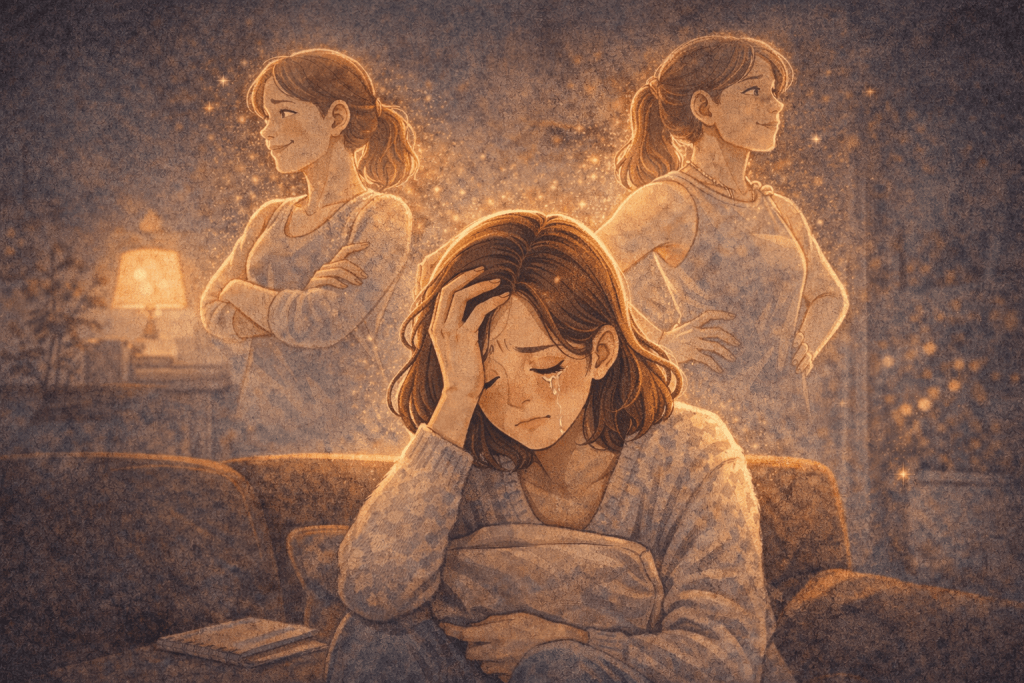
The profile of the "strong person"
I recognize her right away:
He arrives, apologizing for "taking my time."
He tells me, “There are probably people with more serious problems.”
She downplays her pain: “It’s no big deal. Others have it worse.”
And then, when we started working, I realized:
They've been carrying around unprocessed trauma for years (sometimes decades).
He has supported his entire family, his friends, and his colleagues.
He has never asked for help because “that’s not his role.”
His strength isn't a superpower. It's a survival mechanism that no longer serves him.
Why "strong" people don't ask for help
1. His identity is built on being “the strongest”
From a young age, she was taught: “You’re the one in charge. You’re the one everyone relies on.”
Asking for help feels like betraying who he is.
2. They grew up playing the role of an adult when they were little girls
Parentification. They took care of their siblings. They supported their mother. They were the family’s emotional backbone.
They learned: My role is to give, not to receive.
3. Every time they asked for help in the past, it never came
Or worse: they were punished for needing help.
“Stop being so dramatic.” “You’re the strong one—you can’t break down.” “Others need you—you can’t be weak right now.”
They learned: Asking for help is dangerous and/or pointless.
4. Its value depends on its ability to give
“I am valuable because I help others. If I need help, I lose my value.”
This equation is deadly.
5. They have built walls so high that they no longer know how to open up
Years of thinking "I can do it on my own" create emotional barriers that are almost impossible to break through.
Asking for help requires a vulnerability they've forgotten how to tap into.
The Cost of Perpetual Fortress
I've seen these "strong people" show up when:
They have already broken down physically (due to illness or extreme exhaustion).
They've already lost an important relationship because they were never able to open up.
They can't take it anymore, but they don't know how to stop.
The cost of “always having to do it alone”:
Physically:
- Chronic burnout
- Stress-related illnesses
- Exhaustion that rest doesn't cure
- A body that breaks down when the mind refuses
Emotionally:
- Deep loneliness (no one really knows them)
- Built-up resentment
- Inability to receive love
- Feeling trapped in their role
In terms of relationships:
- One-sided relationships (they always give, they never receive)
- Couples who see them as "perfect" but don't really know them
- Superficial friendships
- Children who admire them but don't feel close to them
And the most painful thing:
When they finally break down, they feel guilty for “failing” to be strong.
As if his humanity were a failure.
The Conversation That Changed My Perspective
A client—let's call her María—came to see me after 15 years of “managing on her own.”
She supported her family while her father was ill. She took care of her mother afterward. She worked full-time. She raised two children as a single mother.
Everyone called her "a warrior."
And she came to me completely broken. She couldn't get out of bed. She couldn't function.
During our third session, he said something to me that I will never forget:
“Ceci, I’m so tired of being strong. But if I stop being strong… who am I? What’s my worth?”
And there it was: the trap.
His strength was his identity. But it was also his prison.
We worked together for six months. And the biggest breakthrough wasn't when she "got stronger."
That was when she learned that she can be strong and ask for help. That her worth doesn’t depend on her ability to hold up the world on her own.
For You, Who Can Always Do It on Your Own
If you're reading this and thinking, "That's me"...
I want you to know something:
Your strength is real. You are incredibly capable. You have achieved extraordinary things.
And also:
You deserve help. You deserve a break. You deserve someone to be there for you.
Asking for help isn't a sign of weakness. It's the bravest form of strength.
Because it requires letting go of control, letting down your guard, and embracing your humanity.
And that's much harder than "doing it on your own."
Signs That You Need to Ask for Help (Even If You Don't Want To)
- People describe you as "very strong," but you feel empty inside
- You give constantly, but you have a hard time receiving
- When someone asks, "How are you?" you automatically say, "Fine" (without checking in with yourself)
- Your relationships feel one-sided
- You secretly resent that no one "sees" how much you carry
- The idea of being vulnerable terrifies you
- You've come to accept stress levels that would overwhelm others
- You constantly downplay your pain ("Others have it worse")
- Your body is breaking down, but you keep pushing on
- You read this list and think, “Yeah, but I don’t need help.” ← That’s the biggest sign.
Why I'm Sharing This
Because I know that many of you—the strong ones, the capable ones, the ones who hold everything together—are reading this.
And a part of you is saying: “Yeah, but I’m fine. There are people who need help more than I do.”
That voice is exactly the problem.
Your pain doesn't need to "measure up" to others' to be valid.
You don't have to be "at your absolute worst" to deserve a rest.
Your humanity needs no justification.
And if you've spent decades being strong for everyone…
Maybe it's time for someone to be there for you.
The Invitation
I'm not asking you to "stop being strong."
I ask you to consider that true strength includes being able to be vulnerable.
Please keep in mind that asking for help doesn’t make you weak. It makes you human.
Just know that you deserve the same level of care that you give to others.
And if you don't start now, your body will eventually force you to stop.
It’s better to take a break than to wait for things to fall apart.
💬 A question for you (and for comments):
Are you the type of person who can always handle things on your own?
How long have you been carrying this burden without asking for help?
What would have to happen for you to finally allow yourself to accept it?
You don't need to answer me. But answer yourself.
Because the strongest people I know aren't the ones who never ask for help.
They were the ones who finally had the courage to admit that they needed her.
If you recognized your story here, this is your sign. The courage isn't in going it alone. It's in finally asking for help. 💙
References
- Walker, P. (2013). Complex PTSD: From Surviving to Thriving. Azure Coyote.
- Miller, A. (1981). The Drama of the Gifted Child. Basic Books.
- Brown, B. (2012). Daring Greatly: How the Courage to Be Vulnerable Transforms the Way We Live. Gotham Books.
- Van der Kolk, B. (2014). The Body Keeps the Score.. Viking Press.
- Maté, G. (2003). When the Body Says No: Understanding the Stress-Disease Connection. Wiley.

How to address it comprehensively
At Rebirthing LLC , we understand that anxiety and depression cannot be resolved solely through the mind. That is why we work with Quantum Neurointegration, an approach that combines psychology, neuroscience and quantum medicine to balance body, mind, and energy.