
Imagine for a moment that you have been feeling unexplained anxiety for years. You've tried therapy, meditation, even medication. Your friends tell you that you "have it all," but inside you live with a constant knot in your stomach, as if something terrible is about to happen.
You've analyzed your childhood, reviewed your relationships, worked on your mindset. And even though you've made progress, something is still there. A deep tension that you can't name. A fear that seems to have no origin.
What if I told you that this anxiety didn't start with you?
What if that sense of constant danger comes from a war you never lived through, a famine you never experienced, or a trauma your grandmother suffered 70 years ago?
This is not abstract spirituality or pseudoscience. It is transgenerational epigeneticsand science has shown that trauma can be biologically inherited across generations.
What is the Transgenerational Inheritance of Trauma?
For decades we were taught that we inherited two things from our ancestors: genes and maybe some antique furniture. But epigenetics has revealed a much deeper truth: we inherit the emotional experiences of our ancestors written into our DNA..
Epigenetics is the study of how our experiences can turn certain genes on or off without changing the genetic code itself. Think of it this way: your DNA is like a piano with 88 keys. We all have the same keys (genes), but epigenetics determines which melody is played, which notes sound and which remain silent.
And here's the most surprising thing: those "tunes" can be passed down from parents to children, and even from grandparents to grandchildren.....
When your grandmother lived through a famine, when your grandfather survived a war, when your great-grandmother faced violence, their bodies didn't just experience those events. They recorded them at the cellular and molecular levelThey left chemical marks in their DNA that altered the expression of certain genes.
And those marks can be inherited.
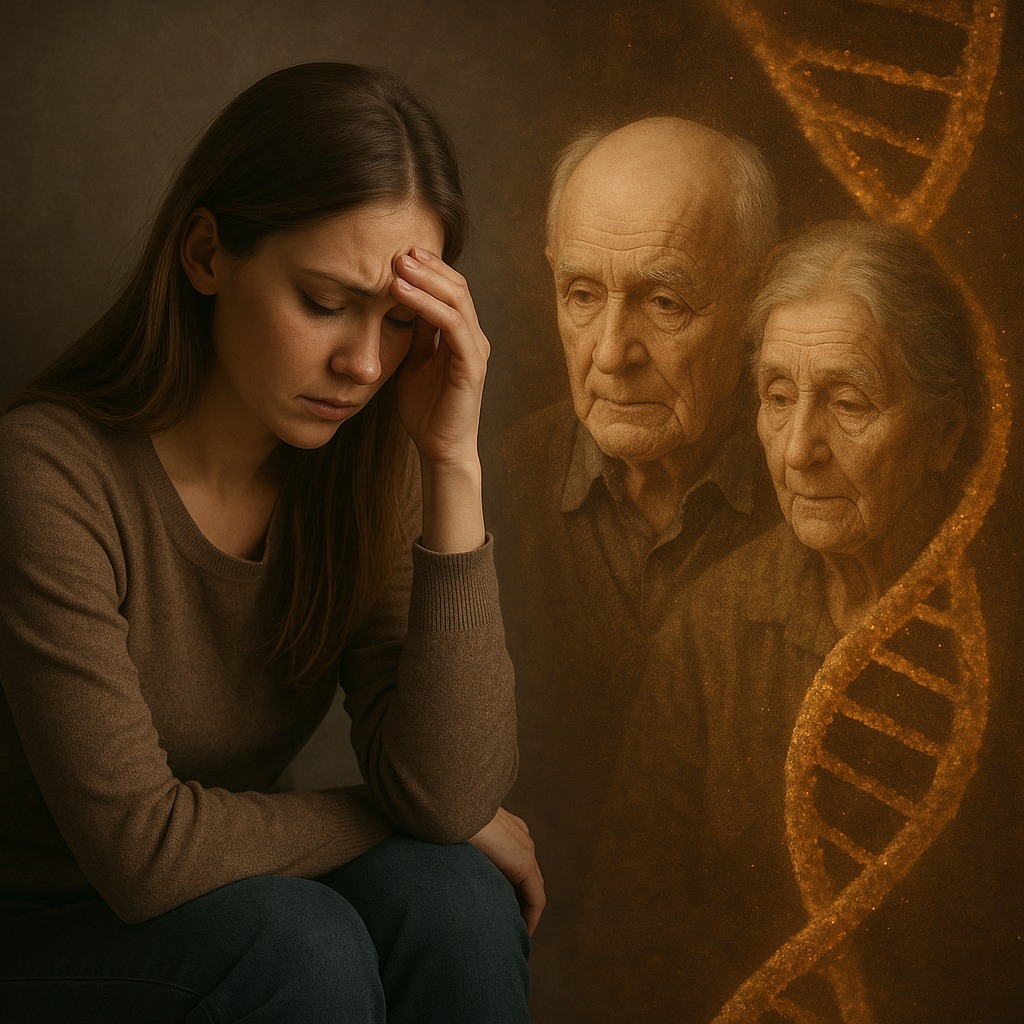
The Invisible Inheritance No One Told You About
The Science That Proves It: Studies That Changed Everything
The Överkalix Study: Your Grandparents' Hunger Affects Your Health Today
In a small town in Sweden called Överkalix, researchers discovered something extraordinary. They analyzed crop and health records spanning more than 100 years, and found a shocking pattern:
If your paternal grandfather experienced an abundance of food during his childhood, you are at increased risk of diabetes and cardiovascular disease..
If you experienced scarcity, your longevity increases.
This means that what your grandfather ate (or didn't eat) between the ages of 9 and 12 affected your current biology, skipping an entire generation.
It was not by social learning or family habits. It was by biologically transmitted epigenetic changes.
Holocaust Survivors: Trauma that Travels in the Blood
One of the most poignant studies came from the analysis of children of Holocaust survivors. Researchers found that these descendants presented:
- Altered levels of cortisol (the stress hormone)
- Increased susceptibility to anxiety disorders and PTSD
- Increased stress responses to everyday situations
- Epigenetic changes in genes related to stress regulation.
Her parents survived, but the trauma did not stay in the past. It traveled into the future, inscribed in the bodies of their children.
A study published in Biological Psychiatry in 2016 demonstrated that extreme trauma can produce measurable epigenetic changes in specific genes (such as the stress response-related gene FKBP5) that are passed on to the next generation.
Identical Twins: Visual Proof of the Power of the Environment
Monozygotic twins share 100% of their DNA. They are genetic clones. However, as they age and experience different experiences, their epigenetic profiles diverge dramatically.
A 2005 study showed that young twins have nearly identical epigenetic patterns, whereas older twins who lived separate lives have significant epigenetic differences in up to 50% of their genes studied.
This shows that your experiences literally rewrite how your DNA expresses itself.. And if your experiences can do it, so can those of your ancestors.
How inherited trauma manifests itself in your body
You may be asking yourself: "How do I know if I'm carrying transgenerational trauma?"
These are some common signs:
1. Anxiety or Fear of No Identifiable Origin
You live with a constant sense of threat even though your current life is safe. Your nervous system is on high alert for no apparent reason.
2. Chronic Hypervigilance
You are constantly scanning your environment for dangers. You can't relax completely. You sleep with your ear to the ground.
3. Disproportionate Reactions
Small situations trigger intense emotional responses that even you don't understand. Your reaction does not match the event.
4. Feeling of "Something Bad Is Going To Happen".
A diffuse fear that you cannot name. A constant expectation of catastrophe.
5. Repetitive Family Patterns
Certain themes run through your family: forced migration, traumatic loss, abandonment, extreme poverty, violence. And although you did not experience them directly, you feel their weight.
6. Unexplained Physical Reactions
Your body tenses up in specific situations without your mind understanding why. Chronic pain without medical cause. Digestive problems related to stress.
Your body remembers what your mind forgot. And sometimes, what your body remembers wasn't even your experience... it was your grandmother's.
Why it matters to know this
Understanding the transgenerational inheritance of trauma is not an academic exercise. It is profoundly liberating for three reasons:
1. Stop blaming yourself
When you understand that your anxiety, your hypervigilance, or your inability to relax may have roots that go beyond your life, you free yourself from the destructive question: "What's wrong with me?"
Nothing is wrong with you. Your nervous system is responding faithfully to inherited information..
2. Explains Unexplained Patterns
Suddenly, reactions that seemed "crazy" make sense. That irrational fear of scarcity even though you've never lacked for anything. That need for control that you can't let go of. That deep-seated distrust of security.
3. Open the Door to Real Healing
The most powerful thing about epigenetics is this: if trauma can be inherited, it can also heal.. Epigenetic changes are reversible.
You are not doomed to carry the pain of your ancestors forever.
[CONTINUED IN PART 2: "How to Release Transgenerational Trauma: The Complete Guide"]
In the second part of this article, you will discover the exact process of Quantum Neurointegration that we use at Rebirthing LLC to release inherited trauma, working on the neurological, bodily, emotional and energetic levels. You will learn the 6 phases of the method and how to become the person in your lineage who breaks the cycle.
References
- Lipton, B. H. (2005). The Biology of Belief: Unleashing the Power of Consciousness, Matter and Miracles.. Mountain of Love/Elite Books.
- Pembrey, M. E., et al. (2006). "Sex-specific, male-line transgenerational responses in humans." European Journal of Human Genetics, 14(2), 159-166.
- Yehuda, R., et al. (2016). "Holocaust exposure induced intergenerational effects on FKBP5 methylation." Biological Psychiatry, 80(5), 372-380.
- Fraga, M. F., et al. (2005). "Epigenetic differences arise during the lifetime of monozygotic twins." Proceedings of the National Academy of Sciences, 102(30), 10604-10609.
- Szyf, M. (2015). "Nongenetic inheritance and transgenerational epigenetics." Trends in Molecular Medicine, 21(2), 134-144.

How to address it comprehensively
At Rebirthing LLC we understand that anxiety is not resolved solely from the mind. That is why we work with Quantum Neurointegrationan approach that combines psychology, neuroscience y quantum medicine to balance body, mind and energy.